What is a Consultant Dermatologist?
Dr Justine Kluk · 3/06/2018
I was recently awarded the title FRCP (Fellowship of the Royal College of Physicians) for my work as a Consultant Dermatologist – a huge honour and something I feel very proud of. “But, what exactly is a Consultant Dermatologist?” you might ask. “And what makes you different from from anyone else who gives skincare advice?” I agree that it can be incredibly confusing to work out who is who with all the different terms and titles that get bandied about by medical professionals, like “Dermatologist”, “Cosmetic Dermatologist”, “Aesthetic Doctor” or “Aesthetic Practitioner”. To understand what sets a Consultant Dermatologist apart and why you should see one if you have concerns about your skin, have a read below: 1. What is dermatology Dermatology is the branch of Medicine concerned with health of the skin, hair and nails. Consultant Dermatologists are medical physicians with the highest training and expertise in this field. 2. What training do Consultant Dermatologists receive? In the UK, aspiring Dermatologists start by competing for a highly sought after place at Medical School. This medical degree takes approximately 5-6 years to complete, at the end of which students receive their primary medical qualification and can start to work as a doctor. Following this, they undertake 2 years of general internal medicine training, usually in a hospital setting. During this time, they experience a number of different medical specialties to broaden their knowledge and are expected to take and pass a series of rigorous board examinations known as the MRCP (membership of the Royal College of Physicians). Upon successful completion of this stage, doctors who are hoping to specialise in Dermatology compete again for what is known as a national training number in order to get onto a Dermatology Higher Specialist Training programme. Dermatology is one of the most popular and competitive medical specialties in the UK so only the top few applicants across the country will be accepted. This specialist training takes another 4 years on average and candidates will typically rotate through a number of hospitals to get the widest possible exposure to different skin conditions in this time. At the end of this period, a specialist examination is taken called the Specialty Certificate Examination. If this is achieved and the doctor has also satisfied their trainers that they are safe and competent to practise independently, the doctor will be awarded a Certificate of Completion of Training (CCT) and be entered on the General Medical Council specialist register as a Consultant Dermatologist recognising that they are the only type of doctor with the requisite training and experience to treat patients with skin concerns that can’t be managed by a GP alone. Some Consultant Dermatologists undertake even further qualifications, known as fellowships, if there is a particular field within Dermatology that they wish to sub-specialise in. For example, I was particularly interested in sun damage and skin cancer so I did a year-long fellowship in melanoma. All of this means that most Consultant Dermatologists will have completed about 13-15 years of medical training before they earn the qualification, meaning they are the safest and most knowledgeable doctor to treat your skin concern. 3. Why should someone go see a Consultant Dermatologist? Anyone who has a problem or concern about their skin can benefit from the advice of a Consultant Dermatologist. Examples of reasons to see a Dermatologist include inflammatory skin conditions like acne, rosacea, eczema or psoriasis, mole checks, skin cancer diagnosis and treatment to name a few. In the UK, you can see your NHS GP for advice first and they may refer you to an NHS Dermatology Department if they deem it appropriate or necessary. Appointments can alternatively be booked directly with the office of a Consultant Dermatologist for anybody who wishes to go privately. It is important to remember that cosmetic skin concerns cannot be treated on the NHS. 4. How do you pick the right Dermatologist for you? If you are being referred to an NHS Dermatology department, you may not have a choice as to which particular doctor you see, however they will either be a Consultant Dermatologist themselves or be under the supervision of one. In the private sector, there are lots of healthcare practitioners claiming to be skin experts so it’s important to do your research before booking an appointment. Firstly, check the General Medical Council (GMC) list of registered medical practitioners to confirm that the doctor is on the specialist register so that you can be assured of their training credentials. The list can be accessed here. Next, ask friends and family (or your GP) if they have someone they can recommend from personal experience as this is a good way of filtering the options. Finally, take a look at the doctor’s website or biography to see if they have particular expertise in your condition and might be a good fit for you. For example, in the past few years my practice has focused predominantly on the treatment of acne and acne scarring so I am considered to have particular clinical expertise in this area, something that you will probably have noticed if you’ve read my blogs or looked at my website. If you are struggling with a skin problem, like acne, and would like effective treatment from someone who knows how it feels to suffer with spots first hand, I’d be delighted to help. Please phone my team on 02037333225 to book an appointment to come and see me. © 2018 Dr Justine Kluk. Any redistribution or reproduction of part or all of the contents of this post in any form is prohibited. You may not, except with our express written permission, copy, distribute or commercially exploit the content. Nor may you transmit it or store it in any other website or other form of electronic retrieval system.
![]()
Dr Justine Kluk · 3/06/2018
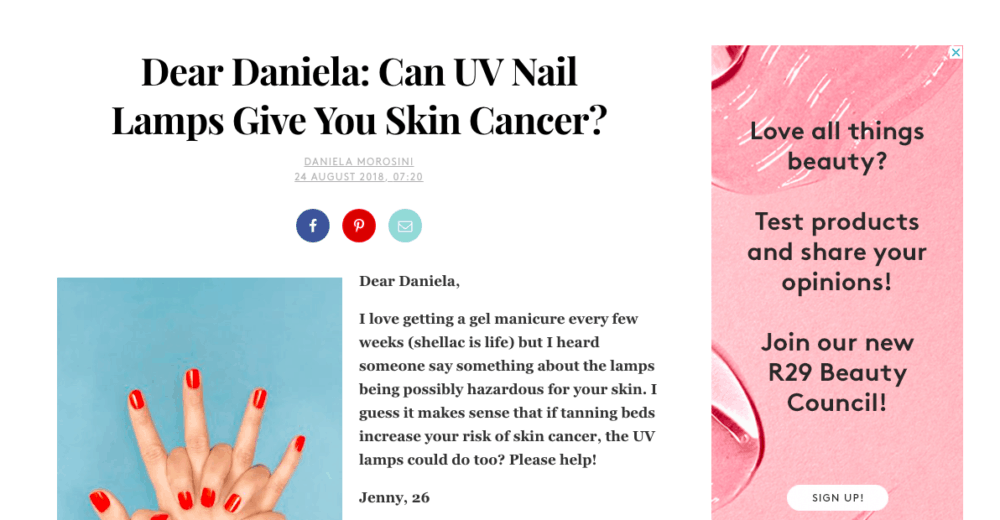
UV nail lamps – Refinery 29
Dr Justine Kluk · 3/09/2018
We know sunbeds and sunbathing are bad news when it comes to increasing our chances of developing skin cancer, but what about the UV lamps used for gel manicures? Daniela Morosini asked me this very question for her recent article in Refinery29 and it turns out the answer isn’t as simple as you might think. My round up of the current evidence is summarised below and a link to the full article in Refinery29 is available here. Whilst there is no doubt that tanning beds increase the risk of skin cancer, current evidence on the carcinogenic risk of UV nail lamps is variable and controversial. Some studies suggest that the risk is clinically significant and there have been a small number of case reports linking the use of UV nail lamps to the development of skin cancer on the hand, whilst other studies have concluded that the exposure risk is negligible and that thousands of individuals would need to use one of these lamps regularly for one to develop a squamous cell carcinoma (a type of skin cancer) on the back of the hand. One of the challenges in quantifying the true risk of UV nail lamps is that research is still very limited on the subject. Even then, some of the existing data suggesting that they are safe to use was conducted by those with a commercial interest in nail products, introducing potential bias when interpreting the outcomes. A further challenge is that there are a multitude of different brands using different types of bulbs. The bottom line is that we don’t yet know for sure whether exposure from typical use of these lamps, for example less than 5 minutes twice per month, does actually increase the risk of skin cancer and until then caution must be advised. Whilst there is no UK guidance so far, the Skin Cancer Foundation in the USA and the American Academy of Dermatology recommend that prior to a gel manicure, clients should apply a broad-spectrum sunscreen to the hands. Given their widespread use, further research is urgently required so that doctors can advise members of the public accurately. © 2018 Dr Justine Kluk. Any redistribution or reproduction of part or all of the contents of this post in any form is prohibited. You may not, except with our express written permission, copy, distribute or commercially exploit the content. Nor may you transmit it or store it in any other website or other form of electronic retrieval system.
![]()
Dr Justine Kluk · 3/09/2018
Dr Justine in Stylist magazine
Dr Justine Kluk · 21/05/2018
I’m so thrilled to have been included in Stylist Magazine’s 7 Skincare Experts You Should Be Following On Instagram this week. This is what beauty journalist Elizabeth Bennett had to say about me: Dr Justine Kluk Best for: Targeted solutions for acne and rosacea Thanks to her extensive experience treating patients suffering from acne and rosacea both in the NHS and her private practice, Dr Justine Kluk is a mine of information on the subject. Her feed is a mix of expert product recommendations, her take on beauty trends (the good and the bad), and an insight into what a dermatologist actually uses on her skin. If you don’t already follow me on Instagram, click here to see what all the fuss is about! © 2018 Dr Justine Kluk. Any redistribution or reproduction of part or all of the contents of this post in any form is prohibited. You may not, except with our express written permission, copy, distribute or commercially exploit the content. Nor may you transmit it or store it in any other website or other form of electronic retrieval system.
![]()
Dr Justine Kluk · 21/05/2018
Sun safety tips
Dr Justine Kluk · 8/07/2018
It seems that summer is here to stay with weather forecasts promising another hot and sunny week! For practical advice about how to protect your skin in the sun, have a read of my tips below: 1. It is always important to protect exposed skin from UV rays to reduce the risk of skin cancer and to prevent premature ageing, pigmentation and exacerbation of skin conditions like rosacea. This is most crucial between April and September in the UK when UV levels are at their peak, but common sense should also apply at other times of year when UV levels are reduced, but not totally absent. 2. Apply a broad spectrum (UVA and UVB) sunscreen with an SPF of 30 or higher to exposed skin 15 minutes before heading outdoors. Look for a non-comedogenic product if you are prone to blackheads or breakouts, meaning that it won’t clog your pores. 3. No SPF offers 100% protection, but the higher the factor the better. For example SPF 15 gives approximately 93% protection compared with 97% for SPF30 and 98% for SPF50. 4. To get the level of protection on the product label, you need to apply the product liberally and in an even layer. As a rule of thumb, a golf ball-sized blob is about the right amount to protect your whole body and a quarter of a teaspoon is about the right amount for your face! 5. Most SPF products will have an expiry date stamped on the packaging or details of when the product should be replaced. In general, sunscreen should be replaced within a year of opening, but mists or sprays may last longer as they are stored in pressurised containers. 6. The terms “mineral” and “physical” sunscreen are often used interchangeably to describe sun protection products that scatter or reflect UV radiation. The primary ingredients in these products are titanium dioxide or zinc oxide. Chemical sunscreens absorb UV radiation and are composed of synthetically-prepared organic chemicals that can be classified as UVA or UVB absorbers. They are often combined with physical sunscreens or with each other to prevent UV radiation from penetrating the epidermis, the skin’s uppermost layer. 7. I would strongly advise against using makeup as your sole form of SPF. We just don’t apply these products in a thick or even enough layer to get anywhere close to the level of protection provided by a typical sunscreen or sun protection moisturiser. Instead, makeup with SPF should be thought of as your second line of defence against UV rays once you’ve already applied sunscreen because two forms of sun protection are better than one. 8. Sweating, swimming and towelling off can reduce the effectiveness of your sunscreen, so it needs to be topped up every couple of hours and as soon as you get out of the pool. Even if you’re just dashing in and out of the office for lunch or on the way home, your sunscreen will lose effectiveness over the course of the day and is likely to have rubbed off a little so care should still be taken with topping up in a city environment. 9. Take extra precautions or head indoors between 11am and 3pm when the sun is directly overhead. Remember that no sunscreen gives 100% protection, so sun avoidance, protective clothing, sunglasses and hats should also be considered. © 2018 Dr Justine Kluk. Any redistribution or reproduction of part or all of the contents of this post in any form is prohibited. You may not, except with our express written permission, copy, distribute or commercially exploit the content. Nor may you transmit it or store it in any other website or other form of electronic retrieval system.
![]()
Dr Justine Kluk · 8/07/2018