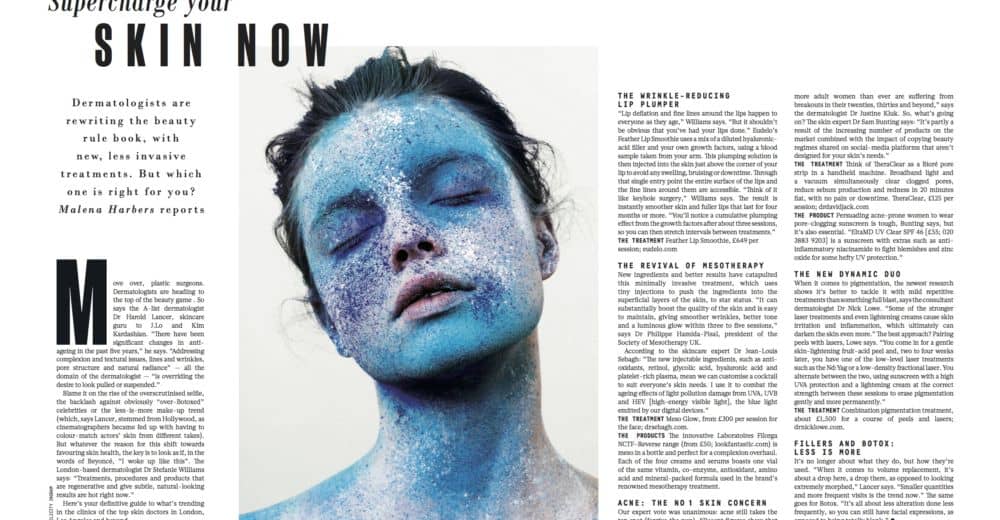
Supercharge your skin – Sunday Times Style
Dr Justine Kluk · 14/05/2017
Supercharge your skin now! Malena Harbers writes about the Dermatologists “heading to the top of the beauty game”. I was thrilled to be featured as one of London’s go-to Dermatologists for acne. © 2017 Dr Justine Kluk. Any redistribution or reproduction of part or all of the contents of this post in any form is prohibited. You may not, except with our express written permission, copy, distribute or commercially exploit the content. Nor may you transmit it or store it in any other website or other form of electronic retrieval system.
![]()
Dr Justine Kluk · 14/05/2017
Why do we get spots and how can we prevent them?
Dr Justine Kluk · 18/07/2017
Spots are probably the most common skin concern of all, affecting as many as 85% of teens at one point or another. Unfortunately, research shows that more and more of us are continuing to suffer with breakouts in our twenties, thirties and beyond meaning that spots are definitely not just a teenage issue. In fact, it is estimated that 10 – 20% of adult women are still battling blemishes. When you think that spots can lead to scarring, poor self-image and loss of confidence, this amounts to a big problem. Before working out how to keep spots at bay, it helps to understand what causes them. There are 3 main reasons that spots occur: Excess sebum production. Sebum is the natural oil produced by our skin. We start making more of it as adolescents which is when spots begin to be a problem for most of us. Build-up of dead skin cells. These dead skin cells mix with the sebum and get trapped in our pores. Bacteria. These bacteria cause inflammation in the skin leading to the angry red bumps and whiteheads that we all dread. In additions to these causes, our genes, diet and lifestyle also play a role in the development of spots. We can’t change our genes, but there are a few lifestyle factors that we can try to address to keep spots at bay. Here are some of my top lifestyle tips for reducing spots: Develop a skincare routine and stick to it every day. It is never too late to start, but it helps to get in the habit from your teenage years onwards. Cleanse your skin well twice daily, follow with a toner to tighten pores and then use a moisturiser designed for spot-prone skin. Using products that aren’t designed for people with breakouts or blemishes can actually make things worse so choose carefully. Consistency is key. Stick to the items in your skincare routine and give them a chance to work. Unless you have a bad reaction to a particular product, I would usually suggest using it regularly for 2 – 3 months before switching if you haven’t noticed an improvement at that point. Don’t fall into the trap of using too many products or chopping and changing every couple of weeks. Similarly, don’t stop using the products when the spots are controlled as you could end up back at square one. Whatever you do, don’t scratch, pick or squeeze. This can introduce bacteria, increased inflammation and may ultimately lead to scarring. Always clean your hands before applying your skincare products and avoid touching your face at other times. Don’t go to bed without removing your makeup. Ideally, you should follow your usual nighttime routine even if it’s late and you’re tired. Keep some cotton pads and a bottle of micellar water next to your bed, however, for those occasions where you may otherwise be tempted to sleep with your makeup on. Greasy hair can contribute to spots on the forehead and around the hairline and neck. If your hair gets greasy easily, keep it tied back off your face and make sure that you wash it regularly. Avoid hats and hair accessories that are likely to trap sweat under your skin and stay away from oily hair serums, gels and waxes that may slide down onto your face blocking your pores. Shower every day. Remove sweaty gym clothes as soon as possible after a workout and don’t delay hopping in the shower. Bacteria thrive in sweaty conditions and can be a particular problem on the back and chest in people who exercise frequently. Change your bedsheets once a week at a minimum. This prevents grease from your pillowcase being rubbed back into your skin. Keep sugary, refined or processed foods to a minimum. This doesn’t mean that you can’t have an occasional chocolate or treat, however. Beyond this, there isn’t a great deal of evidence that cutting particular food groups out of your diet reduces spots. There have, however, been a few small studies suggesting that dairy, especially skimmed milk, may play a role in certain individuals. Always consult with a doctor before cutting anything out of your diet to ensure you are still getting all the nutrients you need. Look after your general health and wellbeing. Lack of sleep and stress can lower your threshold for breaking out. Try to go to sleep at the same time most nights, don’t scrimp on sleep and find ways to let off steam. This may be through doing a hobby, taking a yoga class or relaxing with friends. © 2017 Dr Justine Kluk. Any redistribution or reproduction of part or all of the contents of this post in any form is prohibited. You may not, except with our express written permission, copy, distribute or commercially exploit the content. Nor may you transmit it or store it in any other website or other form of electronic retrieval system.
![]()
Dr Justine Kluk · 18/07/2017
Skincare tips for blemish-free skin
Dr Justine Kluk · 11/08/2016
Breakouts? I’ll be posting my skincare tips for beautiful blemish-free skin this week. No 1: Cleanse your skin morning and evening. Pick a gentle skin cleanser, such as Cetaphil Gentle Cleanser. Wet your face and massage the cleanser into your skin with your fingertips for a minute or so before rinsing and patting dry. No scrubbing, exfoliating, face brushes etc as these simply INCREASE inflammation! This tip is particularly important if you are taking prescription treatment for acne. Many of these prescriptions (e.g. retinoids and benzoyl peroxide) have a drying effect on the skin so an extremely gentle cleanser is of paramount importance in helping you to tolerate your treatment without redness, peeling and irritation. For those with very oily and congested skin, a cleanser containing glycolic or salicylic acid e.g. @SkinCeuticals Blemish + Age cleansing gel may be better suited as these products can help reduce excessive oiliness. No 2: Anyone who has had breakouts has more than likely squeezed a spot before! Although squeezing pimples can make your skin look better in the short term, it can also force the contents even deeper into your skin, increasing inflammation. Squeezing the odd pimple does not always cause scarring, but doing it a lot, and not leaving deeper pimples or nodules alone, almost certainly makes acne worse and increases the likelihood of scarring in the long term. So, bottom line…don’t do it yourself! One option is to have your blackheads professionally squeezed under strict hygienic conditions by a therapist who practices in a dermatology clinic or has been recommended by your dermatologist. Blackheads, or comedones to give them their correct name, are the precursor to all pimples so having these extracted in this way can help control breakouts in combination with the other measures I’ll suggest later on. No 3: My patients often tell me that their breakouts reduce in the sun. There is some truth in this. The sun’s UV rays zap acne-causing bacteria, which is why acne spots may dry up temporarily on sunny holidays. Plus, pimples and red marks look less obvious when your skin is tanned. A few days later, however, redness, bumps and inflammation set in again and you’re back to square one. What’s more, spending too much time in the sun means your blemishes may end up healing with dark scars and spots which can be incredibly difficult to treat or disguise. Beyond acne, UV light also causes free radical damage to the skin, which destroys collagen and elastin, leading to wrinkles. UV rays can also damage the skin’s DNA leading to skin cancer. Acne medication, such as isotretinoin (Roaccutane), tetracyclines and topical retinoids can also make you more sensitive to sunlight, causing your skin to burn faster than it normally would. For all of these reasons, my advice is to stick to your acne skincare routine, and prescription treatment if appropriate, rather than relying on the sun to control your breakouts. Protect your skin from UV rays to prevent permanent scarring and pigmentation. Apply an SPF 30+ broad spectrum (UVA/ UVB) sun protection moisturiser to your face and other exposed sites 365 days a year before you leave the house. These don’t have to be thick and sticky or leave greasy white marks like old-fashioned sunscreens did. Many products now available have the texture of a tinted moisturiser or primer so you can easily layer them under your make-up. Make sure that the label says that the product is non-comedogenic, meaning it won’t clog your pores and increase congestion. My top picks are @janmariniskinresearchPhysical Protectant SPF 30 (tinted), @heliocareuk XF gel SPF 50 (lightly tinted) or 360 gel oil-free SPF 50 (tinted) and @eltamdskincare UV Clear SPF 46 (tinted and plain). Use @garnieruk Ambre Solaire Sensitive Advanced Face Mist SPF50 to top up throughout the day. © 2016 Dr Justine Kluk. Any redistribution or reproduction of part or all of the contents of this post in any form is prohibited. You may not, except with our express written permission, copy, distribute or commercially exploit the content. Nor may you transmit it or store it in any other website or other form of electronic retrieval system.
![]()
Dr Justine Kluk · 11/08/2016
Ageing well – The Telegraph
Dr Justine Kluk · 24/07/2017
How to look gorgeous well into your sixth decade? You could ask Jerry Hall…or you could check out some of the tips I shared with The Telegraph earlier this month. Journalist Victoria Hall selects her top beauty picks to help the cause including Paula’s Choice Anti-Aging Hyaluronic Acid Booster and The Ordinary Hyaluronic Acid Serum http://www.telegraph.co.uk/beauty/skin/beauty-changes-make-60s/ © 2017 Dr Justine Kluk. Any redistribution or reproduction of part or all of the contents of this post in any form is prohibited. You may not, except with our express written permission, copy, distribute or commercially exploit the content. Nor may you transmit it or store it in any other website or other form of electronic retrieval system.
![]()
Dr Justine Kluk · 24/07/2017